by Adele Plunkett | Dec 8, 2015 | Daily Paper Summaries
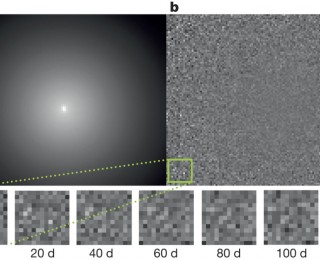
Today we review a study searching for a way to measure the ages of stars in a galaxy. The quantity of long period variable stars gives information about the life cycle of a galaxy, and the authors explain that with their new technique it is possible to take the “pulse” of a galaxy.
by Adele Plunkett | Dec 7, 2012 | Daily Paper Summaries
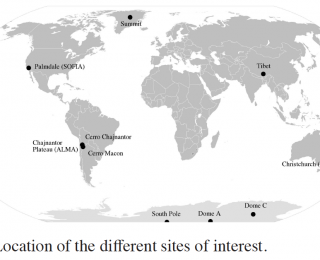
When it comes to planning and building new telescopes, the site selection is an important consideration. This paper evaluates eleven sites around the world, including current and proposed sites of sub-mm observatories, airborne SOFIA locations, and northern-hemisphere sites that could be of interest for future observatories.
by Adele Plunkett | Nov 18, 2012 | Classics, Daily Paper Summaries
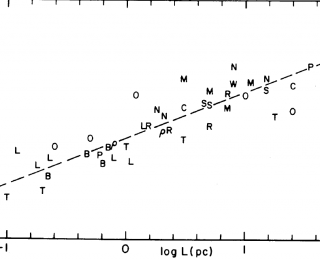
This paper presents three famous relations very important for understanding the inner workings of molecular clouds and star formation processes.

by Adele Plunkett | Oct 12, 2012 | Daily Paper Summaries
A team of astronomers and geologists have teamed up to study the composition of a rocky super-Earth which likely contains a layer of carbon in the form of diamond and graphite.
by Adele Plunkett | Sep 14, 2012 | Daily Paper Summaries
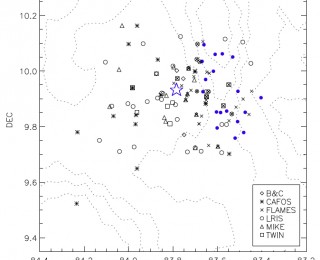
A wealth of observations tell an active accretion story within the Lambda Orionis Star Forming Region, at the head of the Orion constellation.
