archives

Daily paper summaries

This category contains 360 posts

Two types of type Ia supernova?

What if type Ia supernova are not all made the same way? For the first time, a study links type Ia supernova explosions to their parent systems, uncovering evidence for two different ways to produce these purportedly “standard” explosions.

Adolescent Black Holes

We know that supermassive black holes exist, but how did they get so big? In this paper, the authors seek to shed some light on their progenitors – rapidly accreting, intermediate-mass black holes.

No Shocks for This Bow: IBEX Says We’re Wrong

Recent data from IBEX has revealed that our decades-old model of the heliosphere is wrong: there is no bow shock ahead of the heliosphere in the ISM.

Dust-Rich Quasars at z~1.5

How does AGN activity influence star formation in active galaxies? Dai et al. combine multi-wavelength observations of 32 quasars to bring us closer to the answer.

Two (or three?) black holes in one galactic center

It has long been known that galaxies can merge; thus, we should expect their central supermassive black holes to interact as well. However, our ability to study this is limited as most mergers happen in the distant universe. The exceptional nearby source CID-42 can be explained by a recent binary or triple supermassive black hole interaction, giving astronomers a rare chance to witness the repercussions of such an event.

First light from a super Earth

Last year, I reported on how the mystery of 55 Cancri e was resolved. In this Letter, Demory et al. observe the secondary eclipses of 55 Cnc e (when the planet passes behind the star), allowing them to determine the planet’s temperature. At 3,800 degrees Fahrenheit: this super Earth is not looking like a good vacation spot. They are also able to explore possible compositions for the planet.

The biggest black holes may be bigger than we thought

A team of astronomers at the University of Cambridge have uncovered evidence for ultramassive black holes in the giant elliptical galaxies that sit at the center of galaxy clusters. These whoppers could be up to ten times more massive than ordinary supermassive black holes, like the ones we usually find in centers of galaxies.

Witnessing the murder of a star

A luminous ultraviolet-optical flare of radiation reveals the tidal disruption of a star wandering on a quasi-parabolic orbit in the vicinity of a supermassive black hole. This is the most direct evidence yet of a supermassive black hole shredding a star that swirled too close.

Using Mass Loss to Probe Super-Earth Populations

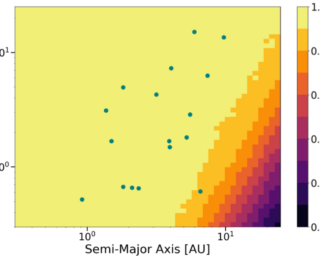
To characterize the newly-discovered population of small planets, this team from UC Santa Cruz investigated how planets lose mass over their lifetimes, and determined how this loss will affect planet populations. This paper suggests that we can understand the population of small planets using mass loss models, and we make predictions using these models for the masses of irradiated super-Earths.

Historical Interlude: Variable Star Observing in the 18th Century

• Paper title: John Goodricke, Edward Pigott, and Their Study of Variable Stars (arXiv: 1204.6241) • Author: Linda M. French • First Author’s Affiliation: Illinois Wesleyan University • Journal: American Association of Variable Star Observers (accepted) Overview One of the things I like about astronomy is its rich history. There are records of astronomical studies [...]

Email Subscription

Archives

Our sister site