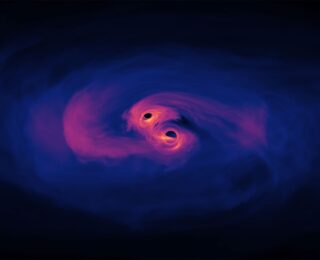
UR: Titans Dancing in the Night Sky: The Search for Supermassive Black Hole Binaries
In this #UndergraduateResearch post, Sebastian Banaszak tells us about his search for Supermassive Black Hole Binaries using simulated optical light curves.

In this #UndergraduateResearch post, Sebastian Banaszak tells us about his search for Supermassive Black Hole Binaries using simulated optical light curves.
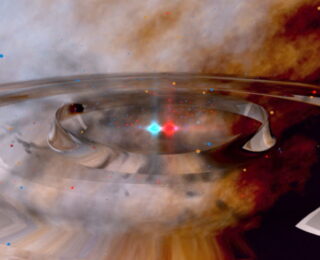
Today’s paper takes a prospective look at possible concerns for future gravitational wave observations, and finds that perhaps no concern is needed.

There’s a space race that can last hundreds of millions of years: the race for two black holes to merge. Find out how we can use the gravitational wave background as our stopwatchin today’s bite!
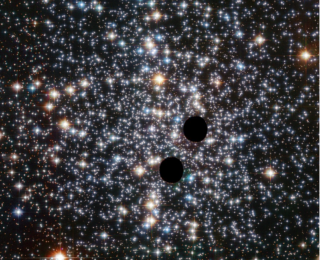
In today’s bite, the authors combine two types of simulations to better understand how intermediate-mass black holes might form in dense nuclear star clusters.
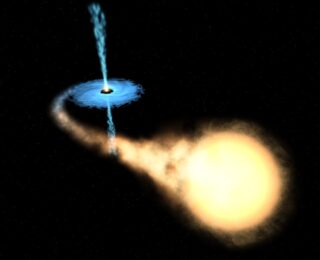
In today’s bite, the authors use simulations to explore turbulence a possible mechanism for the observed x-ray emissions in the coronae of black holes.

In this Astrobite, the authors study the effects of dark matter on merging black hole binaries. As the black holes move through dark matter, they form wakes that slow them down, could this affect the gravitational waves released?