archives

SDSS

This tag is associated with 28 posts

Enhanced star formation in interacting galaxies: how far does it reach?

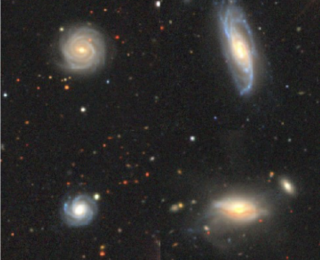
Star formation is enhanced when two galaxies interact or merge. But what is the orbital extent of enhanced star formation in interacting galaxies? At which projected separation of the two galaxies does it disappear?

The mass assembly of Milky Way-like galaxies

The central question of this Letter is how and when the Milky Way assembled its stellar mass. This issue is addressed by tracing the formation history of spiral galaxies which closely resemble the Milky Way.

The cosmic density of dust

Grab the vacuum cleaner… it’s cosmic DUST!

Dust is really ubiquitous in the Universe: it is everywhere from our Solar System to stars and the interstellar medium. However, the observations of dust in galaxies fall short of the prediction of how much dust there is in the Universe. In this work, the authors try to alleviate this problem by estimating the amount of dust present in clouds of gas that inhabit galaxy halos while they look for clues regarding the origin of these clouds.

Observing the Velocity Anisotropy of Cluster Galaxies

Title: Spatial Anisotropy of Galaxy Kinematics in Sloan Digital Sky Survey Galaxy Clusters First Author: Skielboe, A. Galaxy clusters are beautifully simple, but also fantastically complicated structures. For many years, astronomers have treated these systems as spherical cows, but simulations and observations have repeatedly shown that clusters exhibit triaxial rather than spherical shapes with nice [...]

Adding a 3rd Dimension to Galaxy Group Studies

Need to improve a relationship between 2 parameters? Why not try adding a 3rd!

Is God right-handed? Spiral galaxies’ rotation and isotropy

Title: Handedness asymmetry of spiral galaxies with z<0.3 shows cosmic parity violation and a dipole axis Authors: L. Shamir First Author’s Institution: Lawrence Technological University A cherished principle of cosmology is isotropy—that things look the same whatever direction you look.  The cosmic microwave background, radiation left over from 300,000 years after the Big Bang, is [...]

Searching for Signatures of Pair-Instability Supernovae

Scientists search for signatures of pair-instability supernovae in thousands of Sloan Digital Sky Survey Stars.

A new tool to investigate a century old mystery

The current and next generation of large scale spectroscopic surveys could provide new clues in the hunt for the carriers producing mysterious interstellar absorption features.

Red spirals are not dead

The discovery of a population of red spiral galaxies has caused astronomers to questions the relation between galaxy color and morphology: a closer look at their star formation rates reveals a clearer picture.

Hypervelocity stars: what are they running from?

Five new hypervelocity stars have been discovered in the outer regions of the Milky Way. In this paper, the authors discuss what these stars are, how they got so far away, and what their distribution implies about the center of our galaxy.

Email Subscription

Follow us on Twitter

Like us on Facebook

Archives

Our sister site