archives

stars

This tag is associated with 69 posts

Lowest mass exoplanet discovered via direct imaging

The newly discovered planet, HD 65086 b, is the lowest mass planet to be directly imaged.

Kepler light curves are pretty darn precise.

How to Confirm a (Tiny) Exoplanet Candidate

Barclay et al. find a “candidate” planet smaller than Mercury in the Kepler data…will it pass their tests and be confirmed as the smallest known planet?

Using General Relativity to Measure Properties of Binary Pulsars

Shapiro time delays are one of the four tests of general relativity possible in the solar system. Astronomers can use these timing delays to measure properties of binary pulsar systems.

DSS = Digital Sky Survey; DENIS = Deep Near IR Survey of the Southern Sky; 2MASS = 2 Micron All Sky Survey

Checking Out Our New Neighbors

A new brown dwarf system has been discovered only 2 parsec away; Gillon et al. analyze its light curve to study clouds on the surfaces of these stars.

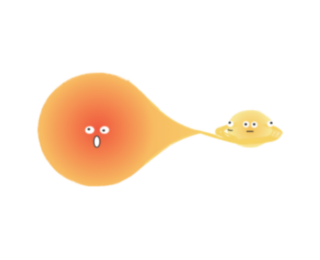
Morpho-Kinematics of a Galactic Nova

Novae are thermonuclear explosions that occur on the surface of a white dwarf following the accretion of matter from a nearby companion star. The authors seek to understand the geometry and velocity of the ejected material.

Evidence for a Universal IMF from a Dwarf Galaxy

Hubble observations of a nearby galaxy show evidence for a universal initial mass function.

White Dwarf Detonation

Exploding diamonds in the sky

Pakmor et al. propose a new mechanism to make Type 1a supernova explosions from a pair of white dwarfs.

Credit: Karen Teramura (UH Institute for Astronomy) with background photograph by Wei-Hao Wang

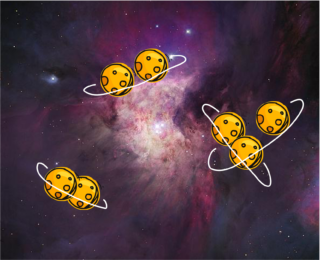
Three’s a Crowd: Potential Triple-Star Systems in the Kepler Field

By looking for variations in the observed periods for eclipsing binary stars, astronomers have found evidence that a sizable fraction of these systems are actually systems of three or more stars.

Finding T Dwarfs with WISE

With the addition of these 87 new T dwarfs, WISE has now tripled the number of known T dwarfs with spectral type later than T5.

Artist's conception of the Milky Way

The Milky Way is cut back down to size

Everything in our galaxy is moving– you, the earth underneath you, the sun, other stars– everything. However, it turns out that figuring out how fast some of these things are moving is surprisingly difficult, and can have Galactic-sized implications!

Email Subscription

Follow us on Twitter

Like us on Facebook

Archives

Our sister site