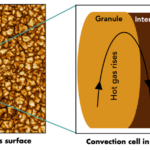
Sometimes we see strange shapes when we look through our fancy telescopes and we’re left wondering how they formed. How did the rings and “pearls” of SN1987A form? Or the hexagonal cloud pattern on Saturn? The star Betelgeuse – famous for being Orion’s left shoulder – presents another unusual geometric appearance.
This paper delves into some of the physical properties of early M dwarfs (M0-M4.5), focusing on chromospheric/magnetic activity and rotation. The authors present a catalog of activity and rotation for 334 early M dwarfs.
Eta Carinae’s Great Eruption is thought to be the paradigmatic “supernova imposter.” But, using light echoes, Rest et al. find that the mechanism causing it is actually a hydrodynamic explosion and not the opaque stellar wind thought to create the other imposters observed.
This paper investigates the interaction between close-in (semimajor axis a<0.15AU) massive planets (a.k.a. “hot Jupiters'') and their host (late-type) stars. Two possible mechanisms for interaction are tidal and magnetic, with the focus of this paper being the latter. The pioneering work on the topic of stellar activity enhancement (such as dark spots, faculae, etc) due to planet interaction is by Cuntz et al. (2000). You can see related contributions about stellar activity on previous astrobites posts.
McLean et al. observe a new sample of late-M and L dwarfs with the Very large Array to search for a relation between rotation rate and radio activity for ultracool dwarfs.
In previous astrobites, we’ve emphasized how important spectroscopy is to an astrophysicist’s understanding of the universe. From radial velocity measurements involved in the discovery of planets, determination of the ionization history of the universe, characterization of P Cygni profiles and more, spectroscopic analysis is a crucial part of an astrophysicist’s toolbox. These sources are faint! If you are impressed by the results obtained by galactic and extra-galactic spectroscopy, be prepared to marvel at the extremely high signal to noise data that can be obtained by observing our brightest source in the sky, the Sun. The sun is truly a spectroscopist’s delight.
Stars are essentially element factories: most of the elements which we know (and dearly love, for life’s sake) were produced by some aspect of stellar evolution, either during their long, uneventful tenancy on the main sequence, shorter and swifter time as a red giant branch star, or their catastrophic death as supernovae.
Stellar variability has received more attention recently due to the problems it poses in the detection of exoplanets; however the study of variability is a field of its own. What causes activity? How does magnetic activity vary with different stars? This paper looks at results from the CoRoT satellite (for Convection, Rotation and planetary Transits), which was launched in December of 2006. This paper is concerned with the long-term photometric microvariability of stars and how stellar activity relates to rotation period and temperature.
Do close-in planets cause their host stars to become more magnetically active? Canto Martins et al. compare stars with and without planets to address this question.
Supernovae, the extremely luminous explosions that are the catastrophic deaths of stars, are used directly and indirectly by astronomers of many disciplines. Cosmologists use type Ia supernovae as powerful “standard candles” to probe the farthest rungs of the cosmic distance ladder. Astrochemists studying the interstellar medium (ISM) track supernovae feedback of heavier elements that enrich the ISM. Astrophysicists working on star formation look for evidence of supernovae-induced collapse of molecular clouds. If supernovae are such ubiquitous tools, then it must be essential to understand the actual supernova (SN) mechanism itself.